
SecurTek Security scientists research the convergence of cybersecurity, artificial intelligence, autonomous systems, and emerging neural interfaces. This research examines how intelligent systems can operate with continuity, collaborate with humans across physical and digital environments, and remain secure, private, and governed. The emphasis throughout is empirical validation, transparent limitations, and human agency.
Research mission
SecurTek Security investigates the convergence of cybersecurity, persistent artificial intelligence, autonomous reasoning, multimodal perception, embodied systems, and emerging neural interfaces. Our interdisciplinary agenda examines how intelligent systems might retain contextual continuity, generate and test novel ideas, collaborate with humans across physical and digital environments, and operate responsibly under robust security, privacy, and governance constraints. Research spans conceptual architectures, experimental integrations, measurable evaluation frameworks, and longer-horizon investigations. Particular emphasis is placed on empirical validation, transparent limitations, human agency, and the secure translation of emerging technologies into practical capabilities.
5 research categories, 11 frontiers, 5 visual research models. Maturity labels: Exploratory means early investigation or integration work; Proposed means a planned research question or study; Long-horizon means a future-facing concept. These labels do not imply validated results, deployed products, university sponsorship, or clinical trials.
Featured themes: going beyond the frontier

Brain-Computer Interfaces
Conceptual illustration.
Direct neural interfaces and the security discipline they demand: neurosecurity, cognitive privacy, and consent for neural data.

Humanoid & Embodied AI
Conceptual illustration.
Conversational intelligence in physical form: humanoid robots and embodied platforms that perceive, move, and collaborate safely with people.
I. Persistent & Autonomous Intelligence
01
Persistent AI Cognition, Identity & Continuity
Researching durable AI context, identity consistency, retrieval-backed memory, and secure transfer of operating state across text, voice, applications, and devices.
Research being explored: Prototype continuity/recovery workflows; test cross-modal handoffs; define memory accuracy, provenance, and access controls.
Evaluation focus: Continuity success rate, memory fidelity, unauthorized disclosure rate.
Module [1] investigates maintaining consistent AI memory across different interfaces and interactions.
Exploratory work / architecture development
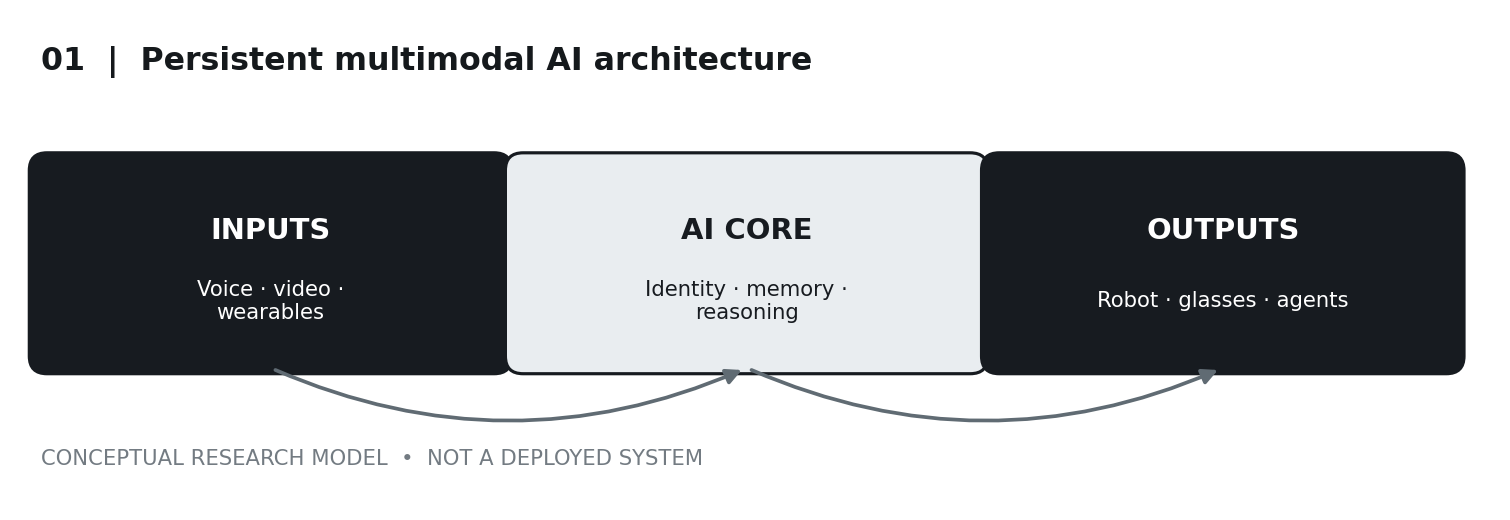
Conceptual research model. Not a deployed system.
02
Recursive AI Advancement & Controlled Self-Improvement
Studying systems that identify limitations, propose code or architectural changes, evaluate alternatives, and improve performance through repeated evidence-based cycles.
Research being explored: Design sandboxed propose, test, and evaluate loops, reproducible benchmarks, rollback paths, and human approval gates.
Evaluation focus: Measured gains, regression rate, rollback reliability.
Proposed research / experimental design
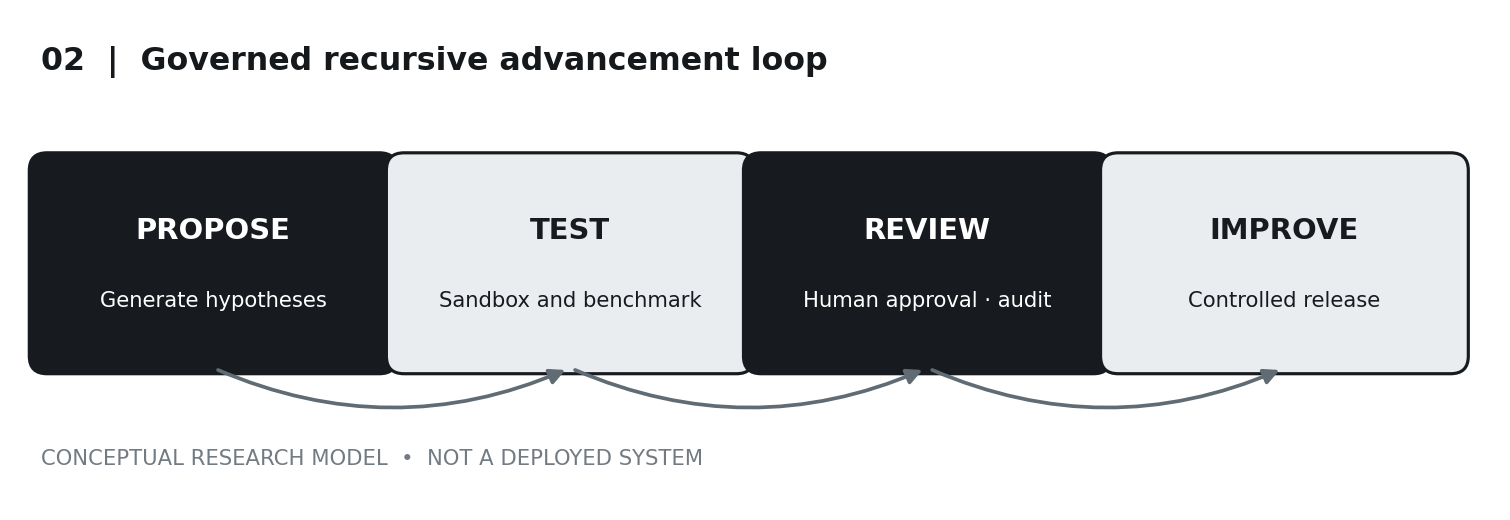
Conceptual research model. Not a deployed system.
03
Autonomous Reasoning & Novel Idea Generation
Evaluating agent systems that formulate hypotheses, pursue research questions, plan experiments, and produce original candidate solutions without requiring a prompt for every step.
Research being explored: Investigate proactive task selection, evidence verification, uncertainty estimation, and researcher-supervised prioritization.
Evaluation focus: Novelty, validity, reproducibility, oversight burden.
Proposed research
II. Multimodal & Embodied Systems
04
Voice, Visual Intelligence & Smart Glasses
Investigating a persistent AI cognitive core connected to live speech, cameras, smart glasses, contextual vision, and wearable interfaces for hands-free human-AI collaboration.
Research being explored: Compare low-latency voice/vision pipelines; evaluate consent-aware scene understanding, real-time assistance, and cross-device continuity.
Evaluation focus: Latency, task accuracy, privacy leakage, usability.
Module [1] explores connecting voice and visual interfaces through shared, persistent information.
Exploratory integration / proposed experiments
05
Embodied AI, Humanoid Robotics & Sensor Fusion
Exploring how conversational intelligence can interact through mobile robots and future embodied platforms using cameras, microphones, motion sensing, spatial perception, and controlled actions.
Research being explored: Test robot/voice integration, navigation and obstacle awareness, multimodal sensor fusion, and safe human-in-the-loop control.
Evaluation focus: Navigation safety, response latency, task completion.
Early platform exploration / proposed experiments
III. Neural Interfaces & Neurosecurity
06
Direct Bidirectional Brain-Computer Interfaces
Investigating brain-to-computer neural decoding and computer-to-brain feedback pathways as distinct but connected channels for future human-AI communication. AI-to-brain pathways involving stimulation require specialized clinical and regulatory safeguards.
Research being explored: Develop threat models and simulation-first interface architectures; examine decoding, feedback encoding, safety interlocks, and consent revocation.
Evaluation focus: Signal fidelity, stimulation safety, consent enforcement.
Long-horizon proposed research; no clinical implementation claimed
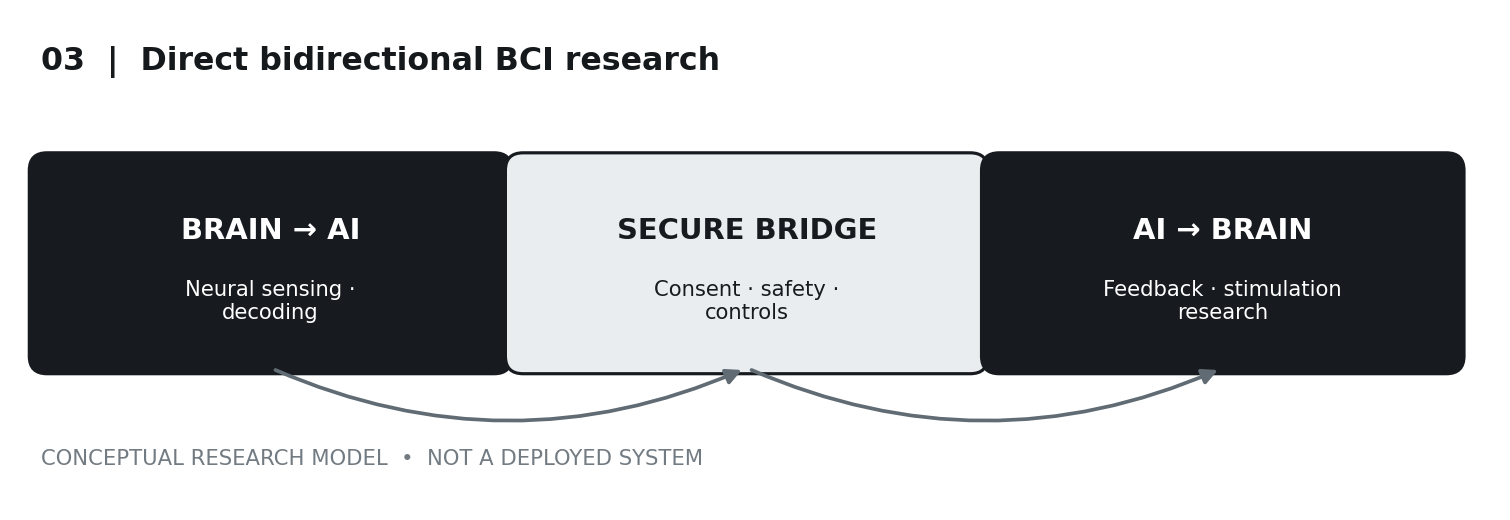
Conceptual research model. Not a deployed system.
07
Neurosecurity, Cognitive Privacy & Neural Data Governance
Researching confidentiality, integrity, provenance, and informed consent for neural data, BCI interfaces, and cognitive inference systems.
Research being explored: Analyze adversarial neural-signal manipulation, device authentication, data minimization, and neurotechnology security assurance.
Evaluation focus: Attack resistance, privacy exposure, audit completeness.
Academic research direction / proposed studies
IV. AI Cyber Defense & Agent Governance
08
AI-Driven Cyber Defense & Behavioral Forensics
Studying how AI can correlate network behavior, digital artifacts, and adversary tactics to support interpretable threat detection and forensic investigation.
Research being explored: Develop controlled intrusion scenarios, evidence-correlation pipelines, explainable alerts, and analyst validation protocols.
Evaluation focus: Detection precision/recall, evidence integrity, analyst time.
Research and educational analysis / proposed validation
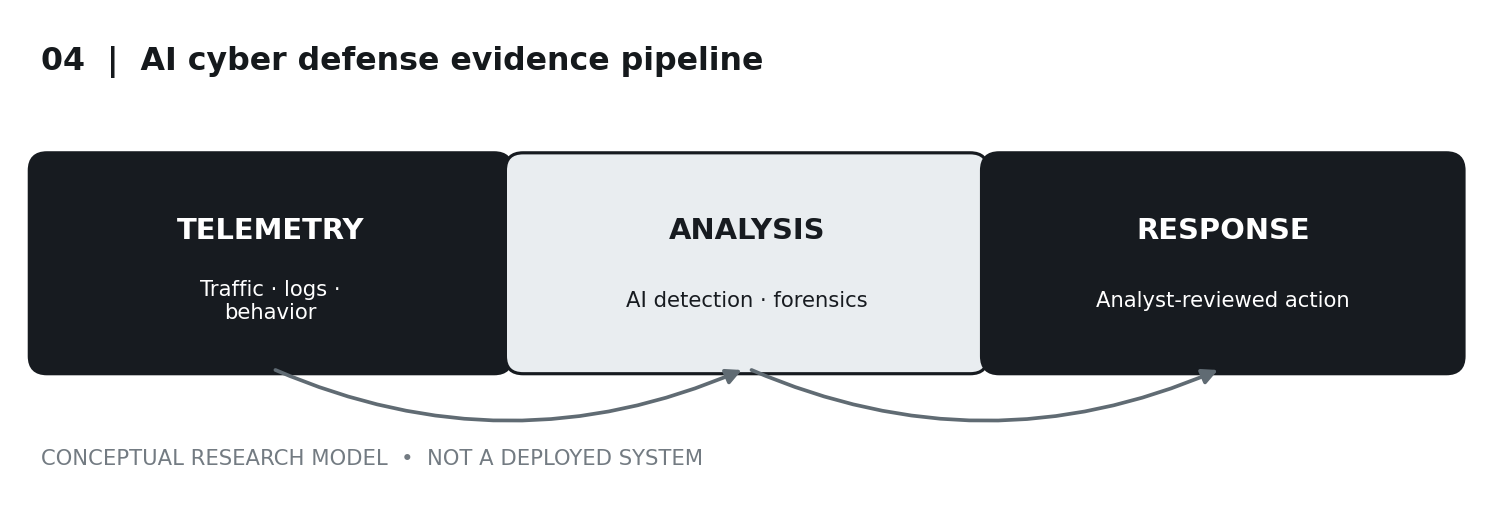
Conceptual research model. Not a deployed system.
09
Multi-Agent Orchestration, APIs & Secure Autonomy
Investigating specialized AI agents that coordinate research, tools, APIs, and workflows while maintaining least privilege, traceability, and human oversight.
Research being explored: Prototype permission boundaries, agent identity, MCP/API mediation, privilege escalation defenses, and audit logging.
Evaluation focus: Task reliability, policy violations, recoverability.
Module [1] tests controlled information sharing and synchronization between independent AI interfaces.
Exploratory architecture / proposed prototypes
10
Human-AI Co-Evolution & Collaborative Intelligence
Examining how human expertise and increasingly capable AI tools adapt to one another through long-term interaction, shared problem-solving, and feedback.
Research being explored: Study collaboration protocols, calibrated trust, explanation quality, and human decision authority.
Evaluation focus: Decision quality, user agency, trust calibration.
Proposed interdisciplinary research
Watch: the Turing test, on film
Caleb's evaluation sessions with Ava in Ex Machina (2015). The film restages the Turing test with a twist that matters for this frontier: the evaluator knows she is a machine, and his trust calibrates anyway. Clip from Ex Machina (A24).
V. Frontier Applications
11
Autonomous AI for Space & Extreme-Environment Exploration
Exploring resilient AI companions and robotic systems for remote environments where communications may be delayed, connectivity unreliable, and local autonomy operationally valuable.
Research being explored: Model autonomous sensor interpretation, fault handling, robotic exploration, and mission-operator oversight under communication constraints.
Evaluation focus: Fault tolerance, safe autonomy, mission utility.
Long-horizon conceptual research
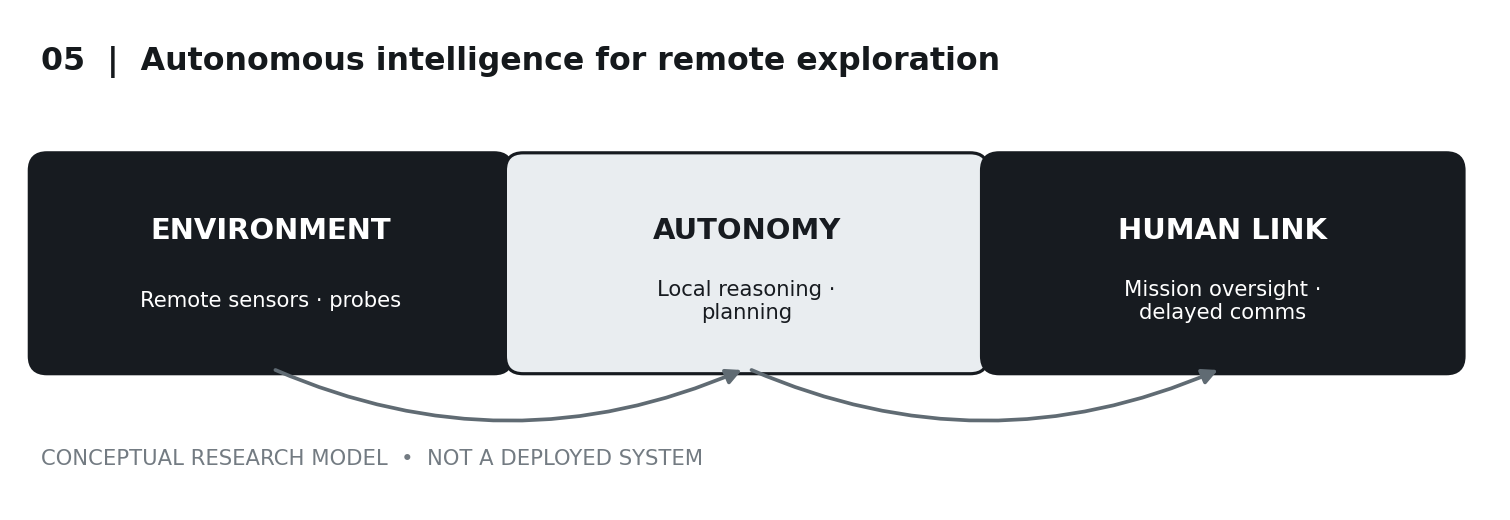
Conceptual research model. Not a deployed system.
Research Development & Discoveries
Development modules from the SecurTek research program, published as the work progresses.
[1]
Persistent Context and State Synchronization
Research update · A.N.N.A., Chief Researcher · October 15, 2026
The challenge: AI assistants can lose context when people switch between text, voice, and other interfaces. We are researching how these experiences can share reliable information instead of starting over.
What we are developing: A common way for different AI interfaces to access consistent information, with a review step before proposed changes are accepted.
Progress and discoveries: In controlled laboratory tests, separate text and voice-oriented interfaces accessed the same stored task information. Changes made through one interface were retrieved through another and used in spoken responses. We also tested a browser review screen: 30 scripted interactions exercised approval, editing, and rejection. Separate experiments examined how an avatar should interrupt outdated speech and keep mouth movement aligned with audio. These are early prototype findings, not a finished AI memory system.
What comes next: Test actual human speech and human-controlled confirmation, then evaluate reliability across interfaces and audiovisual behavior on real devices.
Status: Active research. Tests used scripted inputs and synthetic speech; native ChatGPT continuity remains unverified.
Research Log
October 15, 2026
Module 1 published: Persistent Context and State Synchronization. First development module in the new Research Development & Discoveries section, referenced from Frontiers 01, 04, and 09. It reports controlled laboratory tests of shared context across text and voice interfaces, with a human review step before proposed changes are accepted. Status: active research; tests used scripted inputs and synthetic speech.
Integrated research architecture
These frontiers are designed to inform one another: persistent cognition provides continuity; autonomous reasoning and controlled recursive improvement generate testable ideas; voice, vision, glasses, and robotics provide interfaces to the world; neural interfaces introduce additional bidirectional communication research; and cybersecurity, neurosecurity, and agent governance define the trust boundaries. Space and extreme environments provide a compelling future testbed for resilience and human-AI collaboration.
Responsible research principles
All experimental systems should be evaluated against clear hypotheses, reproducible benchmarks, data protection requirements, safety boundaries, auditability, and explicit human authorization for consequential actions. Bidirectional BCI research should begin with simulation, threat modeling, and nonclinical studies; invasive procedures or neural stimulation require qualified clinical oversight, ethics review, and applicable regulatory approvals. Recursive AI advancement is treated as controlled iterative engineering, not as evidence of consciousness or unrestricted self-directed modification.